Home › Fear
Self-hypnosis for fear and phobias
A session built around one specific situation — the flight, the lift, the motorway — rehearsed slowly enough that your body stops treating it as an emergency.
Why hypnosis helps with a specific fear
A fear is rarely argued away. The reaction arrives before the reasoning does: the chest tightens, the attention narrows, and the situation is over before any sensible thought gets a turn. Guided hypnosis works on the part that moves first — slow, paced language settles the body, and a settled body reacts differently to the same trigger.
From there the session rehearses the scene rather than avoiding it. You walk through the boarding gate, the roundabout, the glass lift, at a pace you can stay calm through. Repeated rehearsal is what makes the real thing feel familiar instead of sudden.
What a session works on
- The physical spike — breath, chest, hands — slowed deliberately before the scene begins.
- Avoidance itself: the situation gets smaller every time it is faced calmly in rehearsal.
- An anchor to use in the moment: a breath, a word, a gesture that recalls the session.
- Your own situation, if you type it in — a flight next month, a driving test, a tunnel.
How Onira builds your session
- You pick a theme and, if you want, type a sentence or two about what is actually going on.
- An AI model running on your phone writes the script — induction, deepening, imagery, suggestions, anchoring, then a clear return to full alertness.
- Narration starts as soon as the opening is ready and the rest keeps writing while you listen, so a full 15 to 30 minute session begins in seconds.
- Keep a session you liked and replay the exact same narration whenever you want.
What to expect
Sessions run roughly 15 to 30 minutes. You stay aware throughout, and the session always closes by bringing you back to full alertness — so it can be used the morning of the flight, not only the night before. Most people listen with headphones somewhere they will not be interrupted.

The session narrates itself while a slow-breathing background plays.

Free, no account, no subscription. One-time purchase to remove ads.
Common questions
Can self-hypnosis cure a phobia?
No. Guided relaxation and mental rehearsal are a self-help tool, and many people find them useful for an everyday fear. A phobia that limits your life is treated by a clinician — often very effectively — and that is the conversation to have.
Should I listen during the flight itself?
You can, and many people do. The session ends by returning you to full alertness, so it is safe before or during — but never while driving, even a session about driving.
Do I have to describe what scares me?
No, the theme alone works. If you do describe it, the detail makes the rehearsal sharper — and it stays on your phone, because the model runs locally.
Private by design
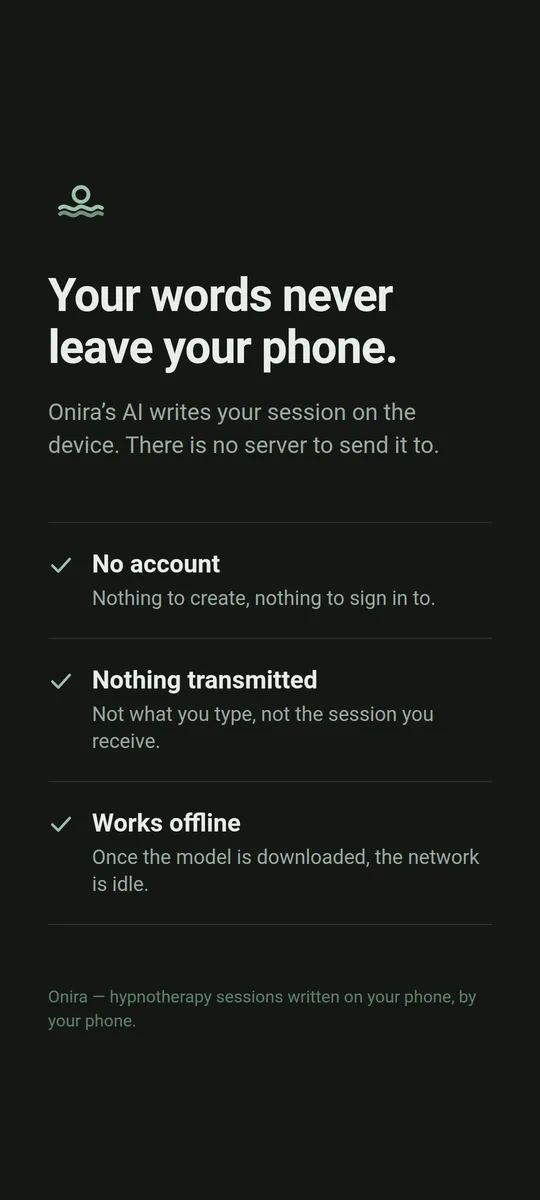
Onira runs its model on your device. The theme you pick, the words you type and the session you receive are never uploaded — there is no account, no cloud generation and no server that could read them.
Not a medical treatment
Onira is a relaxation and self-hypnosis tool. It is not therapy, not medical or psychiatric advice, and not a substitute for professional care or emergency services. If you are in distress or in danger, contact a local crisis line or emergency number.
Other themes
- AnxietyLoosen the grip of anxious thinking and settle the body.
- SleepWind down a busy mind and let sleep arrive on its own.
- ConfidenceRehearse being the version of yourself you already know how to be.
- StressCome down from a demanding day and recover properly.
- Quitting smokingSupport a decision you have already made, craving by craving.
- FocusSettle a scattered mind before work that needs your attention.
- WeightWork on habits and the relationship with food, not on rules.
- MemorySettle into the state where studying actually sticks.
- MotivationStart the thing you have been circling for a week.
- Nervous habitsInterrupt nail biting or jaw clenching before it runs.
- PainEase the bracing and the dread that make pain louder.
- IBSCalm the gut-brain loop that keeps flare-ups going.
- Emotional recoverySettle after something hard, without reliving it.
Questions people ask
- Falling asleepThe method, step by step, for the nights your mind will not stop.
- Hypnosis vs meditationTwo states, two aims — and which one fits what you want tonight.
- Does it work?What the evidence supports, what it does not, and who it fails.
- Street hypnosisReal, not mind control — and the same mechanism works on yourself.
- Is it safe?Safe for most people, with a short list of real exceptions.
- Learning itWhat to practise, in what order, and how long it really takes.