Home › Hypnosis vs meditation
Hypnosis vs meditation
They look similar from the outside — eyes closed, slow breathing, a calm voice — and they are aimed at two different things.
The short answer Meditation trains attention: you practise noticing where the mind went and bringing it back, without trying to change what you find. Hypnosis uses a relaxed, focused state to rehearse something specific — sleeping, staying steady in a meeting, not reaching for the cigarette. If you want a general skill, meditate. If you want to work on one named thing, a hypnosis session is the more direct tool.
What is actually different
Both practices produce a similar physiological state: slower breath, lower arousal, narrowed attention. The difference is what you do once you are there. A meditation keeps returning you to a neutral anchor and asks nothing of the content of your mind. A hypnosis session takes that same settled state and puts suggestion into it — images, phrases and rehearsals aimed at one outcome.
That is also why hypnosis is structured and meditation often is not. A session has an arc: an induction that settles you, a deepening, imagery, the suggestions themselves, an anchor to carry out, and a deliberate return to full alertness. Each part exists to make the next one land.
What each one is good at
Neither is a better practice in the abstract. They answer different questions, and the honest way to choose is by what you want in the next month rather than by which sounds more serious.
- Meditation, for a general relationship with your own attention: less reactivity, more room between a feeling and what you do about it. It pays off slowly and broadly.
- Hypnosis, for a specific target: falling asleep, a fear of flying next Tuesday, the first ten minutes of a task you keep avoiding, a habit you want interrupted.
- Meditation asks you to stop chasing an outcome, which is exactly what makes it frustrating when you have one.
- Hypnosis is outcome-shaped, which makes it easier to start with and easier to over-claim for — no session rewrites a life in one sitting.
Is one of them better evidenced?
Both have a real literature and both have more enthusiasm than evidence around the edges. Mindfulness-based programmes have the larger body of clinical work, mostly around stress, relapse in depression and chronic pain. Clinical hypnotherapy has a narrower but genuine record — pain and procedural distress are its strongest showing, with useful results for sleep onset and irritable bowel symptoms.
What neither has is a claim to replace treatment. Both are adjuncts: things that help alongside care, not instead of it.
You do not have to pick one
A common and sensible pattern is meditation as the daily practice and a hypnosis session for the specific thing that is in the way this week. They do not compete; if anything, regular meditation makes the settling stage of a session faster.
Onira sits on the hypnosis side of this. You pick the target, add a sentence about what is actually going on, and a model running on the phone writes a session around it, then narrates it — no account, nothing uploaded, and nothing generic about the imagery.
Try it tonight

The session narrates itself while a slow-breathing background plays.

Free, no account, no subscription. One-time purchase to remove ads.
Common questions
Can hypnosis make me do something I do not want to do?
No. In a self-hypnosis session you stay aware and in control throughout, and suggestions that cut against what you actually want simply do not take. Stage hypnosis is entertainment built on volunteers who are willing to play along, and it is not what a therapeutic session is.
Which is better for anxiety?
For anxiety as a general pattern, meditation has the better long-run evidence. For a specific anxious situation you can name — a flight, a presentation, a scan — rehearsing it in a hypnosis session tends to be more useful than sitting with the breath.
Is guided meditation the same as hypnosis?
It is the nearest thing. A guided meditation that visualises an outcome and repeats suggestions is doing most of what a hypnosis session does; the label differs more than the practice.
Private by design
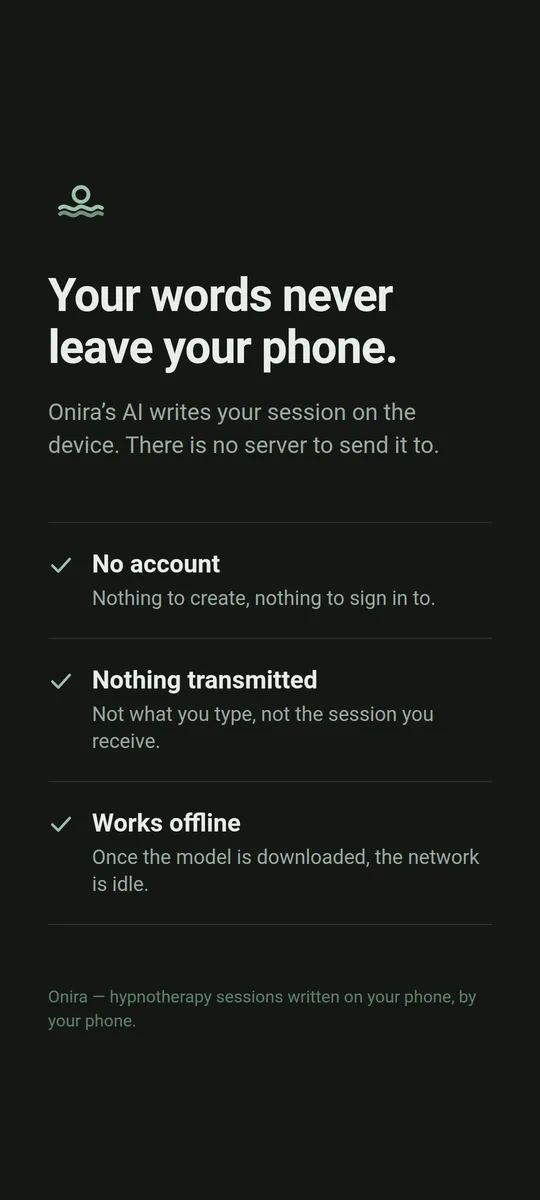
Onira runs its model on your device. The theme you pick, the words you type and the session you receive are never uploaded — there is no account, no cloud generation and no server that could read them.
Not a medical treatment
Onira is a relaxation and self-hypnosis tool. It is not therapy, not medical or psychiatric advice, and not a substitute for professional care or emergency services. If you are in distress or in danger, contact a local crisis line or emergency number.
What a session works on
- AnxietyLoosen the grip of anxious thinking and settle the body.
- SleepWind down a busy mind and let sleep arrive on its own.
- ConfidenceRehearse being the version of yourself you already know how to be.
- StressCome down from a demanding day and recover properly.
- Quitting smokingSupport a decision you have already made, craving by craving.
- FocusSettle a scattered mind before work that needs your attention.
- WeightWork on habits and the relationship with food, not on rules.
- FearFace the flight, the drive or the height with a rehearsed calm.
- MemorySettle into the state where studying actually sticks.
- MotivationStart the thing you have been circling for a week.
- Nervous habitsInterrupt nail biting or jaw clenching before it runs.