Home › Learning it
How to learn self-hypnosis
It is a skill with a short syllabus and a slow first fortnight — here is the order that works and the part everyone gets wrong.
The short answer You can learn self-hypnosis on your own, and most people who get anywhere do it in the same order: relax the body deliberately, narrow attention onto one thing, then give yourself a specific suggestion and repeat it nightly for two or three weeks. Expect the state to feel unremarkable — absorbed, like a good book, not unconscious — and judge it by whether the target moves, not by how deep it felt. A guided recording is the easiest way to start, because reading instructions to yourself competes with the relaxing.
The order that works
The pieces are simple. Doing them in this order is what stops the first week feeling like nothing is happening.
- **Set the situation up.** Somewhere you will not be interrupted, phone silenced, lying down or sitting back. Deciding to check something halfway through is what ends most early attempts.
- **Relax on purpose, in stages.** Hands, jaw, shoulders, breathing — longer out than in. This is the part people skip, and it is the part that makes the rest possible.
- **Narrow your attention.** A slow count down from twenty, a single image, the feeling of your own breathing. One thing, held loosely.
- **Give one suggestion, in the present and in the positive.** Not "I will not panic" but "my breathing stays slow and I stay steady". Rehearse it as a scene, in detail, rather than repeating it as a phrase.
- **Come back deliberately.** Count up, open your eyes, be fully alert. This matters for the habit, not for safety.
What it actually feels like
This is where most people conclude they cannot do it. The expectation is something dramatic — a threshold, a click, a sense of going under. The real thing is closer to being absorbed in a film: the room recedes a bit, time gets unreliable, and you could stop at any moment but do not particularly want to.
Which means feeling nothing special says very little. Judge the fortnight on the target instead: minutes to fall asleep, whether you started the avoided task, how a stressful hour went. If the number moves, it is working, whatever it felt like.
How long it takes
The first sessions are for learning the shape, not for results. A fair expectation is that relaxing gets noticeably easier within a week, and that anything you are actually aiming at takes two to three weeks of near-daily practice to shift.
Responsiveness also varies between people and is fairly stable over a lifetime — roughly one in four respond strongly, about as many barely respond at all. If three or four honest attempts do nothing whatsoever, the reasonable conclusion is that this is not your tool, not that you need to try harder.
Can you learn it from a book, or on your own?
On your own, yes — it is one of the few things in this field that genuinely does not need a practitioner. From a book, partly: books are good for understanding what you are doing and poor as a live guide, because reading instructions to yourself is the opposite of narrowing your attention.
That is the practical argument for a recording. Something else holds the structure and the pacing while you do the only part that cannot be delegated, which is letting it work. Once the shape is familiar, doing it unaided gets much easier.
Learning self-hypnosis is not learning to hypnotise people
Worth separating, because the searches run together. Hypnotising someone else is a performance and an interpersonal skill, with consent and calibration to learn, and it is taught in courses. Self-hypnosis is a private routine aimed at one of your own problems.
Being good at the second tells you almost nothing about the first, and the reverse is also true.
Where Onira fits
Onira writes the session for you and narrates it aloud: you pick a theme and, if you want, type a sentence about what is actually going on. That removes the two things beginners struggle with — holding the structure, and finding the words for a suggestion that fits your situation.
It is free, works offline, and nothing you type leaves your phone. If you later want to run sessions in your head without it, that is a fine outcome and the app will have done its job.
Try it tonight
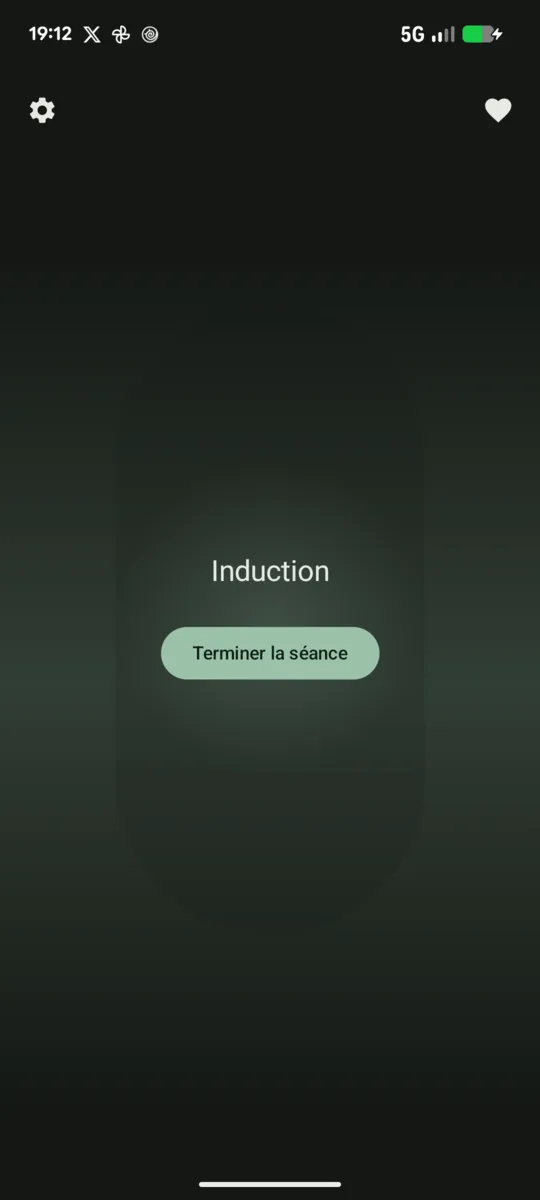
The session narrates itself while a slow-breathing background plays.

Free, no account, no subscription. One-time purchase to remove ads.
Common questions
How long should a session be?
Fifteen to thirty minutes suits most purposes. Shorter works once the skill is familiar; much longer mostly adds drifting off, which is fine if sleep was the point and wasted otherwise.
What time of day is best?
Whenever you can be uninterrupted, with one caveat: sessions aimed at anything other than sleep end by returning you to full alertness, so bedtime is not automatically the right slot.
Do I need to write my own script?
No, and writing one while trying to relax is the classic beginner trap. Start with something that narrates for you, and write your own later if you find you want to.
Can I learn it if my mind never stops?
That is the normal starting condition, not a disqualification. The staged physical relaxation exists precisely because a racing mind will not narrow on command — the body goes first and the mind follows.
Is self-hypnosis the same as meditation?
Related but aimed differently. Meditation trains a general relationship with your attention; self-hypnosis points that attention at one specific target. The practice overlaps, the intent does not.
Private by design
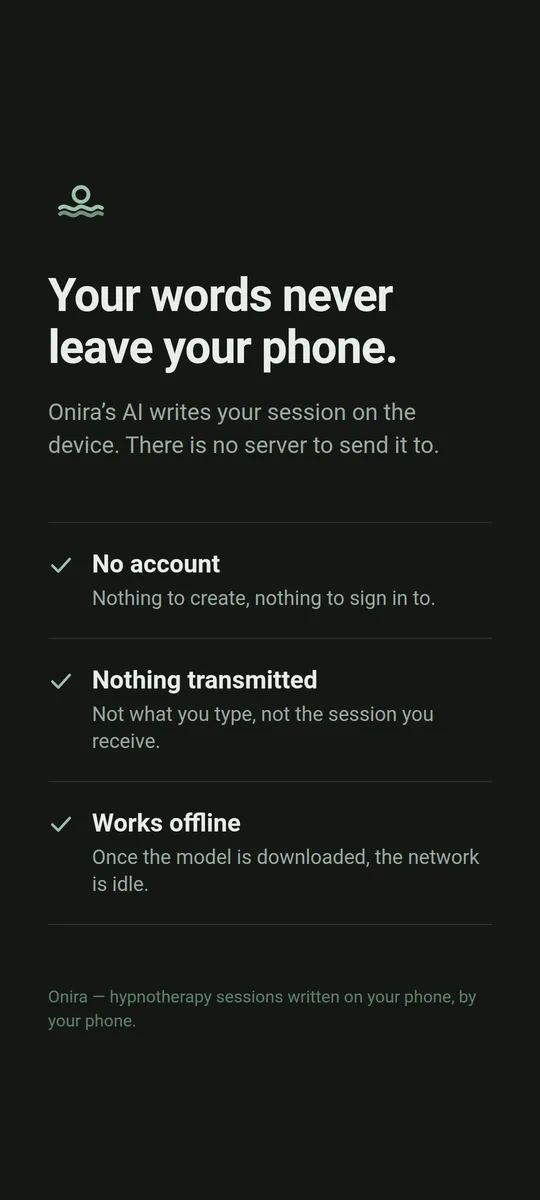
Onira runs its model on your device. The theme you pick, the words you type and the session you receive are never uploaded — there is no account, no cloud generation and no server that could read them.
Not a medical treatment
Onira is a relaxation and self-hypnosis tool. It is not therapy, not medical or psychiatric advice, and not a substitute for professional care or emergency services. If you are in distress or in danger, contact a local crisis line or emergency number.
What a session works on
- AnxietyLoosen the grip of anxious thinking and settle the body.
- SleepWind down a busy mind and let sleep arrive on its own.
- ConfidenceRehearse being the version of yourself you already know how to be.
- StressCome down from a demanding day and recover properly.
- Quitting smokingSupport a decision you have already made, craving by craving.
- FocusSettle a scattered mind before work that needs your attention.
- WeightWork on habits and the relationship with food, not on rules.
- FearFace the flight, the drive or the height with a rehearsed calm.
- MemorySettle into the state where studying actually sticks.
- MotivationStart the thing you have been circling for a week.
- Nervous habitsInterrupt nail biting or jaw clenching before it runs.
- PainEase the bracing and the dread that make pain louder.
- IBSCalm the gut-brain loop that keeps flare-ups going.
- Emotional recoverySettle after something hard, without reliving it.
Questions people ask
- Falling asleepThe method, step by step, for the nights your mind will not stop.
- Hypnosis vs meditationTwo states, two aims — and which one fits what you want tonight.
- Does it work?What the evidence supports, what it does not, and who it fails.
- Street hypnosisReal, not mind control — and the same mechanism works on yourself.
- Is it safe?Safe for most people, with a short list of real exceptions.