Home › Street hypnosis
How street hypnosis works
The stiff arm, the frozen handshake, the volunteer who forgets their own name — what is going on there, and how much of it is real.
The short answer Street hypnosis is real, and it is not mind control. What the hypnotist uses is suggestion, expectation and the volunteer's own willingness to go along with the frame — plus a quick screening step that finds the people who respond strongly, because roughly one person in four does. Nobody is controlled, nobody loses their memory of it, and nobody does anything they would genuinely refuse. The same mechanism, minus the theatre, is what self-hypnosis uses when you direct it at yourself.
What is actually happening
Hypnosis is focused attention plus suggestion. Narrow someone's attention hard enough, give them a clear expectation of what is about to happen, and suggestions start being acted on before the usual critical checking gets involved. That is the whole mechanism, on a street corner or in a session.
The street version adds two things a recorded session cannot. First, a person who is socially committed: they stopped, they agreed, people are watching, and backing out now would be its own small embarrassment. Second, selection — the hypnotist tries several people and keeps the ones who respond, which is why the clips you see are all successes.
The stiff arm and the frozen handshake
The set pieces are less mysterious than they look, and each one has a job:
- **Suggestibility tests** — the stiff arm that will not bend, hands stuck together, eyelids that will not open. These come first because they tell the hypnotist how responsive someone is before anything bigger is tried.
- **Convincers** — the same tests, doing a second job. Feeling your own arm refuse to bend is far more persuasive than being told it will, and that belief makes the next suggestion land harder.
- **Pattern interrupt** — the handshake induction. An automatic social action is started and then broken mid-way, leaving a half-second of blankness, and a clear instruction is dropped into it. It is surprise used as a doorway, not a magic word.
- **Compliance and rapport** — the unglamorous ingredient. The volunteer wants this to work. That is not cheating; wanting it is part of how suggestion works at all.
Is it real, or are they actors?
Mostly real, with the caveat that you are watching an edit. Responsiveness to hypnotic suggestion varies between people and is fairly stable across a lifetime: around one in four people respond strongly, about the same proportion barely respond at all, and the rest sit in between. A street hypnotist finds the first group and films them.
What is not real is the loss of self. Volunteers stay aware throughout, remember it afterwards, and can stop whenever they decide to. The dramatic part — someone unable to recall their name for ten seconds — is a temporary suggestion someone is going along with, not an off switch.
Is hypnosis illegal?
Doing it is generally legal, and performing it in public is what gets regulated rather than the thing itself. The United Kingdom is the clearest example: the Hypnotism Act 1952 requires a licence from the local authority before hypnotism is performed as public entertainment. Elsewhere the rules vary by country and sometimes by city, and some places restrict who may use hypnosis in a clinical context.
The part that matters more than licensing is consent. Hypnotising a stranger who has not clearly agreed is not a prank, and "they said yes after I started" is not agreement. If you try any of this, ask first, take no for an answer, and leave anyone who seems distressed alone.
What it means if you want to try it on yourself
Here is the part the videos bury: the mechanism does not need an audience, a stranger, or a handshake. Attention, expectation and suggestion are the working parts, and all three are available when you are the one giving the instructions. What you lose is the spectacle. What you gain is that you can point it at something you actually want — sleep, a fear, a habit, the hour before a difficult conversation.
It is also slower and duller than a street clip, and honest about it: the effect comes from repetition over weeks, not from one dramatic moment. If you are in the quarter of people who respond strongly, you will notice quickly. If three or four honest attempts do nothing, this is probably not your tool.
Where Onira fits
Onira writes self-hypnosis sessions on your phone and narrates them aloud — you pick a theme, optionally say what is actually going on, and a model running on the device writes the script and speaks it. It is the self-directed side of what you have been watching, aimed at sleep, anxiety, confidence, habits and the rest.
It does not teach street hypnosis and will not make you a hypnotist. It is free, works offline, and nothing you type leaves the phone.
Try it tonight

The session narrates itself while a slow-breathing background plays.

Free, no account, no subscription. One-time purchase to remove ads.
Common questions
Can someone hypnotise me against my will?
No. Suggestion needs your cooperation, and that is why street hypnotists ask for volunteers rather than picking targets. Someone who does not want to participate simply does not respond.
Will I do something embarrassing?
Not something you genuinely object to. People under suggestion decline things that cross their own lines, which is well documented and also why stage shows stick to harmless material. The risk at a show is social, not psychological.
Is the stiff arm proof that someone is hypnotised?
No — it is a suggestibility test. It shows how readily someone accepts a suggestion, which is useful information, but it is a step before anything resembling a hypnotic state, not evidence of one.
Can I learn street hypnosis from Onira?
No, and it is worth being straight about it. Onira writes self-hypnosis sessions for you to listen to; it does not teach you to hypnotise other people. If that is what you are after, you want a course, not this app.
Do people remember what happened?
Yes, in almost every case. Suggested amnesia is a temporary effect in suggestible people, and it wears off. Waking up with a blank stretch of missing life is a film convention.
Private by design
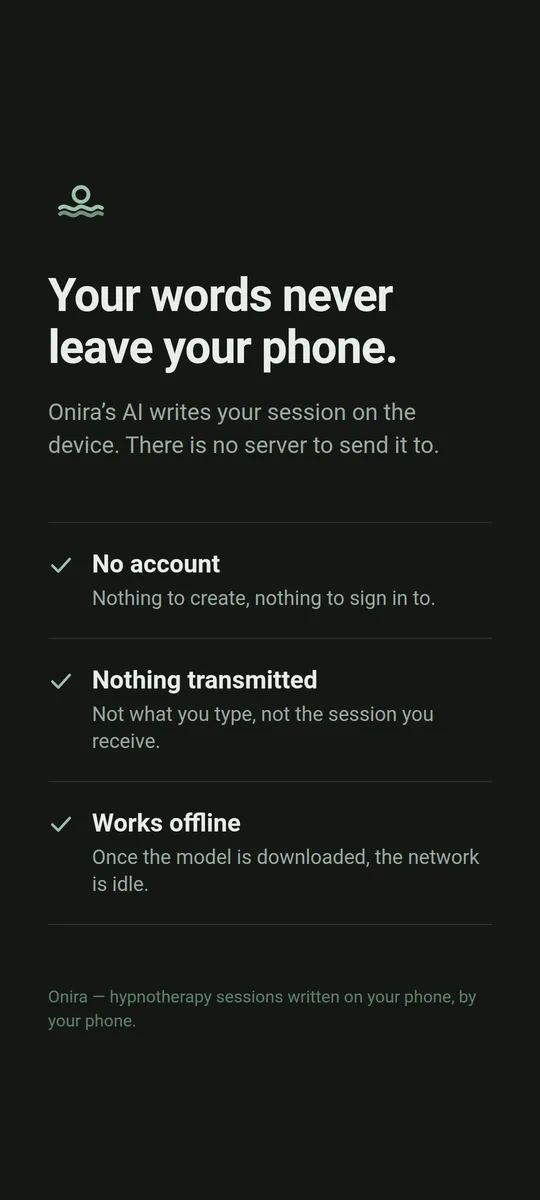
Onira runs its model on your device. The theme you pick, the words you type and the session you receive are never uploaded — there is no account, no cloud generation and no server that could read them.
Not a medical treatment
Onira is a relaxation and self-hypnosis tool. It is not therapy, not medical or psychiatric advice, and not a substitute for professional care or emergency services. If you are in distress or in danger, contact a local crisis line or emergency number.
What a session works on
- AnxietyLoosen the grip of anxious thinking and settle the body.
- SleepWind down a busy mind and let sleep arrive on its own.
- ConfidenceRehearse being the version of yourself you already know how to be.
- StressCome down from a demanding day and recover properly.
- Quitting smokingSupport a decision you have already made, craving by craving.
- FocusSettle a scattered mind before work that needs your attention.
- WeightWork on habits and the relationship with food, not on rules.
- FearFace the flight, the drive or the height with a rehearsed calm.
- MemorySettle into the state where studying actually sticks.
- MotivationStart the thing you have been circling for a week.
- Nervous habitsInterrupt nail biting or jaw clenching before it runs.
- PainEase the bracing and the dread that make pain louder.
- IBSCalm the gut-brain loop that keeps flare-ups going.
- Emotional recoverySettle after something hard, without reliving it.
Questions people ask
- Falling asleepThe method, step by step, for the nights your mind will not stop.
- Hypnosis vs meditationTwo states, two aims — and which one fits what you want tonight.
- Does it work?What the evidence supports, what it does not, and who it fails.
- Is it safe?Safe for most people, with a short list of real exceptions.
- Learning itWhat to practise, in what order, and how long it really takes.