Home › Falling asleep
How to fall asleep with self-hypnosis
A practical method for the nights when the body is tired and the mind is still running — and an honest account of what it can and cannot do.
The short answer Lie down, let your eyes close, and count slowly down from twenty, letting each number land on an out-breath. At every number, release one specific place — jaw, shoulders, hands. When you reach one, picture a single quiet scene in as much sensory detail as you can hold, and stay in it. The point is not to force sleep; it is to give the mind one slow thing to do instead of the fast ones it had planned.
Why counting yourself down works
Insomnia at the start of the night is rarely a lack of tiredness. It is a mind that has been given nothing to do and has filled the gap with tomorrow. Self-hypnosis works on that gap directly: a slow, repetitive, mildly demanding task occupies exactly the attention that would otherwise rehearse an argument or a deadline.
The descending count matters more than the number. Counting down implies arrival, and pairing each number with an out-breath slows the breath without you having to think about breathing — which is the reliable way to shift the nervous system out of its alert setting.
The method, step by step
None of this needs training, and none of it needs you to believe in anything. It needs about fifteen minutes and a willingness to start over when you drift into thinking, which you will.
- Set the room up first: dark, cool, phone face down. Deciding to check something halfway through is what ends most attempts.
- Lie on your back, arms at your sides, and take three breaths that are longer on the way out than on the way in.
- Count down from twenty. Say each number silently as you breathe out.
- With each number, release one place: jaw, tongue, shoulders, hands, stomach, thighs, feet. Naming the place is what makes it let go.
- At one, choose a scene — a beach at dusk, a path through trees, a room you remember — and fill it in: the temperature, the sound, what is underfoot.
- When you notice you have wandered off into thinking, do not start again from twenty. Pick the count back up wherever you left it and carry on.
What to do when it does not work
The first few attempts often end in a wandering mind, and that is not failure — it is the ordinary way attention behaves before it settles into a habit. What changes the outcome is repetition at the same time of night, so the sequence itself becomes a cue.
If you are still awake after twenty minutes or so, get up, keep the lights low, and do something dull until you feel sleepy. Lying in bed fighting for sleep teaches the body that bed is a place where you fight for sleep, which is the one association worth protecting against.
Where a written session helps
Doing this from memory means part of you is running the instructions, which is part of you staying awake. Being narrated to removes that job: you follow a voice instead of remembering a list, which is why guided sessions work better than self-directed ones for most people at bedtime.
Onira writes the session on your phone around what is actually keeping you up — if you type that you cannot stop replaying a conversation, the imagery and suggestions are built on that rather than on a generic beach. It runs the model on the device, so nothing you type is uploaded, and it works with the phone offline and face down.
Try it tonight
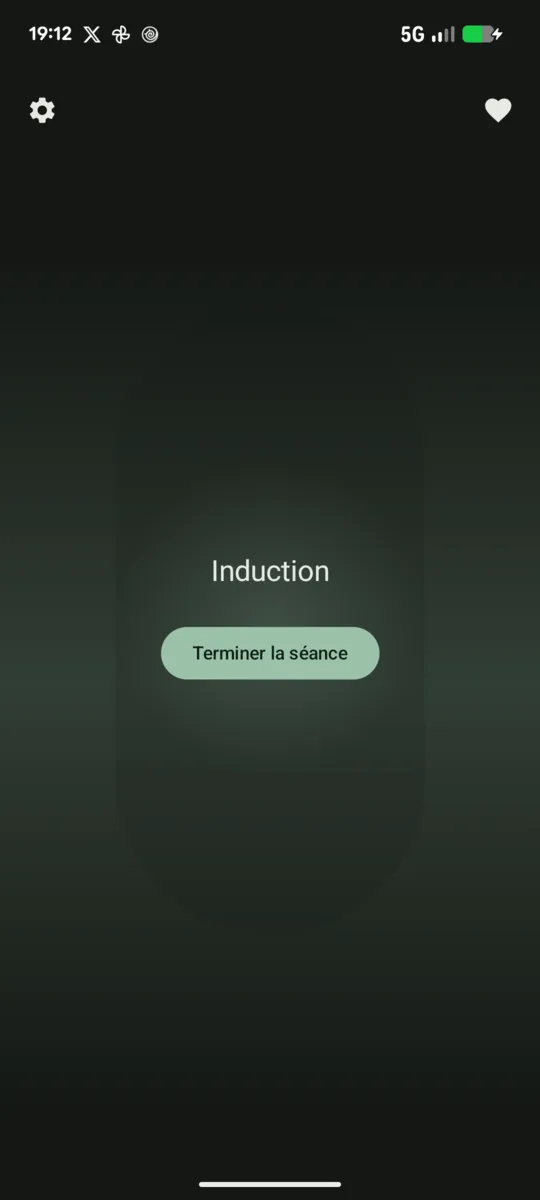
The session narrates itself while a slow-breathing background plays.

Free, no account, no subscription. One-time purchase to remove ads.
Common questions
How long does it take to fall asleep this way?
Most people who get on with it fall asleep somewhere in the scene rather than at the end of the count — often fifteen to twenty-five minutes in. If you are regularly still awake at the end, treat it as a signal to look at the hours before bed rather than to try harder in bed.
Is self-hypnosis safe to do at night?
For ordinary sleeplessness, yes — it is guided relaxation, and the worst common outcome is that you stay awake. It is not a treatment for a sleep disorder, and persistent insomnia, sleep apnoea or insomnia alongside low mood are matters for a doctor.
Can I use a recording instead of doing it myself?
Yes, and for falling asleep a recording is usually better: it removes the job of remembering the steps. What a recording cannot do is mention the thing you are actually turning over, which is the gap a session written in the moment fills.
Private by design
Onira runs its model on your device. The theme you pick, the words you type and the session you receive are never uploaded — there is no account, no cloud generation and no server that could read them.
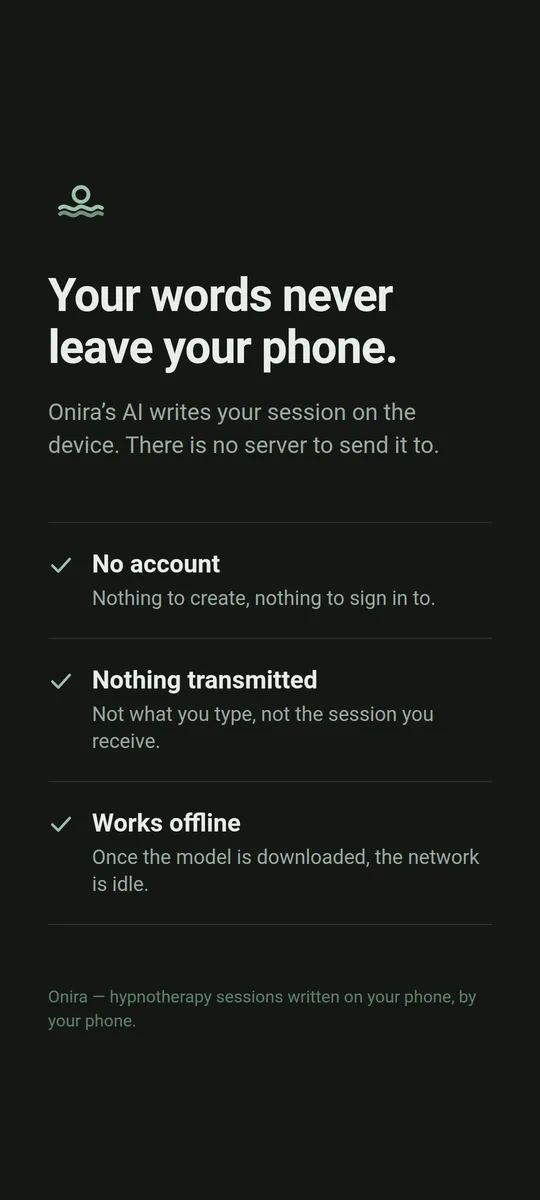
Not a medical treatment
Onira is a relaxation and self-hypnosis tool. It is not therapy, not medical or psychiatric advice, and not a substitute for professional care or emergency services. If you are in distress or in danger, contact a local crisis line or emergency number.
What a session works on
- AnxietyLoosen the grip of anxious thinking and settle the body.
- SleepWind down a busy mind and let sleep arrive on its own.
- ConfidenceRehearse being the version of yourself you already know how to be.
- StressCome down from a demanding day and recover properly.
- Quitting smokingSupport a decision you have already made, craving by craving.
- FocusSettle a scattered mind before work that needs your attention.
- WeightWork on habits and the relationship with food, not on rules.
- FearFace the flight, the drive or the height with a rehearsed calm.
- MemorySettle into the state where studying actually sticks.
- MotivationStart the thing you have been circling for a week.
- Nervous habitsInterrupt nail biting or jaw clenching before it runs.