Home › Is it safe?
Is self-hypnosis safe?
For most people, yes — and the real risks are duller and more specific than the ones people worry about.
The short answer Self-hypnosis is safe for most healthy adults. You cannot get stuck in it, lose control, or be made to do something against your will — those are film conventions. The genuine cautions are narrower: never listen while driving or operating anything, treat it as a complement rather than a replacement for prescribed care, and talk to a doctor first if you live with psychosis, a dissociative disorder, bipolar disorder or PTSD. For children, epilepsy and pregnancy the answer is usually yes with supervision, which is worth asking about rather than assuming.
The risks people worry about, and what is actually true
Almost every fear about hypnosis comes from fiction, so it is worth clearing them out before the real ones:
- **Getting stuck.** Not possible. Without a voice guiding you the state simply fades, or turns into ordinary sleep. The deliberate return to alertness at the end of a session is for comfort, not rescue.
- **Losing control.** Suggestion needs your cooperation. You stay aware, you remember it, and you decline anything that crosses your own lines — which is exactly why stage shows ask for volunteers.
- **Being reprogrammed without noticing.** Nothing is installed. What repetition changes is a habit of response, slowly, and only in a direction you were already pointed.
- **Weakening your mind.** There is no evidence that ordinary relaxation and suggestion harm anyone's judgement, attention or willpower.
The risks that are real
They are less dramatic, and mostly about context rather than the state itself.
- **Doing it while doing something else.** Never with headphones on while driving, cycling, cooking or minding a child. This is the most likely way to come to harm, and it is entirely avoidable.
- **Using it instead of treatment.** A session that eases pain or anxiety can make it tempting to skip an appointment or reduce a prescription. That is the decision to be most careful about, and it belongs to your doctor.
- **Unexpected distress.** Relaxing deeply can let a feeling surface that you were holding down — grief, anger, a memory. For most people this passes; if a session reliably leaves you worse, stop and talk to someone qualified.
- **Memory.** Suggestion makes recall less reliable, not more. Anything that offers to recover forgotten events is doing something the evidence does not support.
When to ask a doctor first
None of these are absolute bans, and most people in these situations use relaxation tools without trouble. They are the cases where a professional who knows your history should weigh in before an app does.
- **Psychosis or schizophrenia** — relaxation and suggestion are not recommended without clinical supervision.
- **Dissociative disorders or PTSD** — deep relaxation can trigger dissociation or intrusive memories. Trauma work belongs with a trained clinician.
- **Bipolar disorder** — generally fine when stable; worth discussing before using it during an episode.
- **Epilepsy** — audio relaxation is not a known seizure trigger, but conditions differ enough that it is a fair question for your neurologist.
- **Pregnancy** — usually fine, and hypnosis for birth preparation is well established. Mention it at an appointment rather than guessing.
- **Children** — self-hypnosis can suit older children with adult guidance. Onira is written for adults and is not designed for young children.
Is it safe for anxiety specifically?
For everyday anxiety, yes, and it is one of the things guided relaxation is best at — lowering the physical arousal that feeds the thinking. The distinction that matters is between everyday anxiety and an anxiety disorder: the first is a reasonable target for a relaxation tool, the second is a reasonable target for treatment, and using the tool alongside that treatment is fine.
One practical note: if listening at bedtime makes you more alert rather than less, that is common and not a warning sign. A session written for sleep ends differently from one written for calm.
Where Onira fits
Onira writes self-hypnosis sessions on your phone and narrates them aloud, for sleep, anxiety, confidence, habits and the rest. Every session ends by bringing you back fully alert, and every theme page carries the same line this guide does: it is a relaxation tool, not therapy and not medical advice.
It is free, runs offline, and nothing you type leaves the device — which also means nobody is profiling what you were anxious about.
Try it tonight
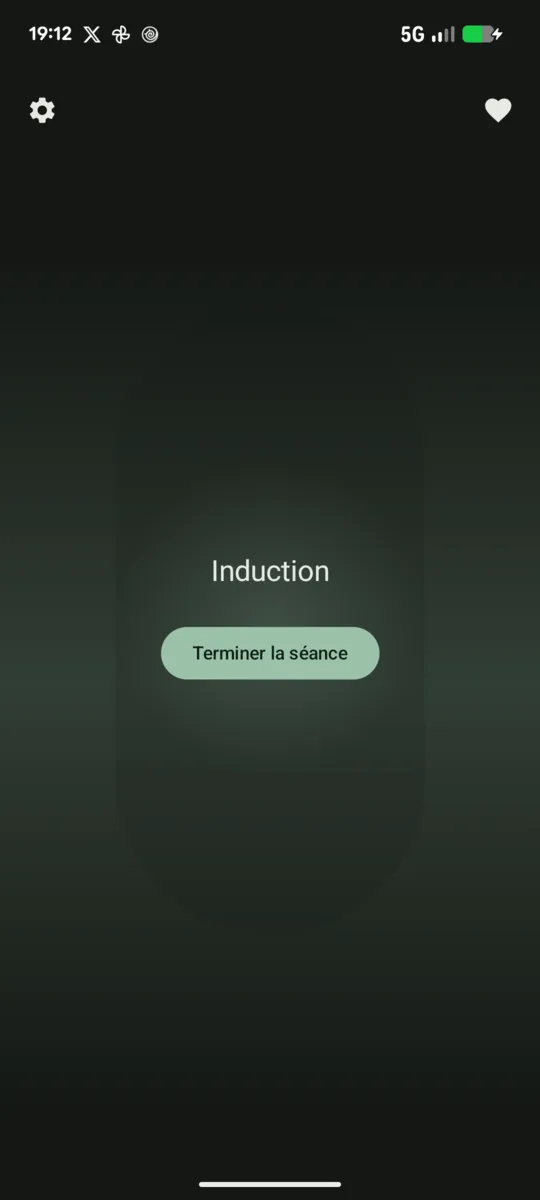
The session narrates itself while a slow-breathing background plays.

Free, no account, no subscription. One-time purchase to remove ads.
Common questions
Can self-hypnosis make my mental health worse?
It is unlikely for most people, and possible in specific conditions — psychosis, dissociative disorders, and trauma when approached directly. If you live with any of those, make it a question for your clinician rather than an experiment.
Is it safe to listen every night?
Yes. Daily use is how the effect accumulates, and there is no known downside to it. The usual limit is practical: a session that keeps you up reading the screen is worse than the sleep you were after.
Can I get addicted to it?
No, in the dependence sense. People do get attached to a routine that works, which is ordinary rather than a problem — unless it is replacing care you actually need.
Is it safe for kids?
With adult guidance and age-appropriate material, often yes; relaxation is used with children in clinical settings. Onira is written for adults, so it is not the right tool for a young child.
What should I do if a session upsets me?
End it, open your eyes and come back to the room — that is always available and nothing keeps you under. If it happens more than once, treat it as a signal to work with a person rather than an app.
Private by design
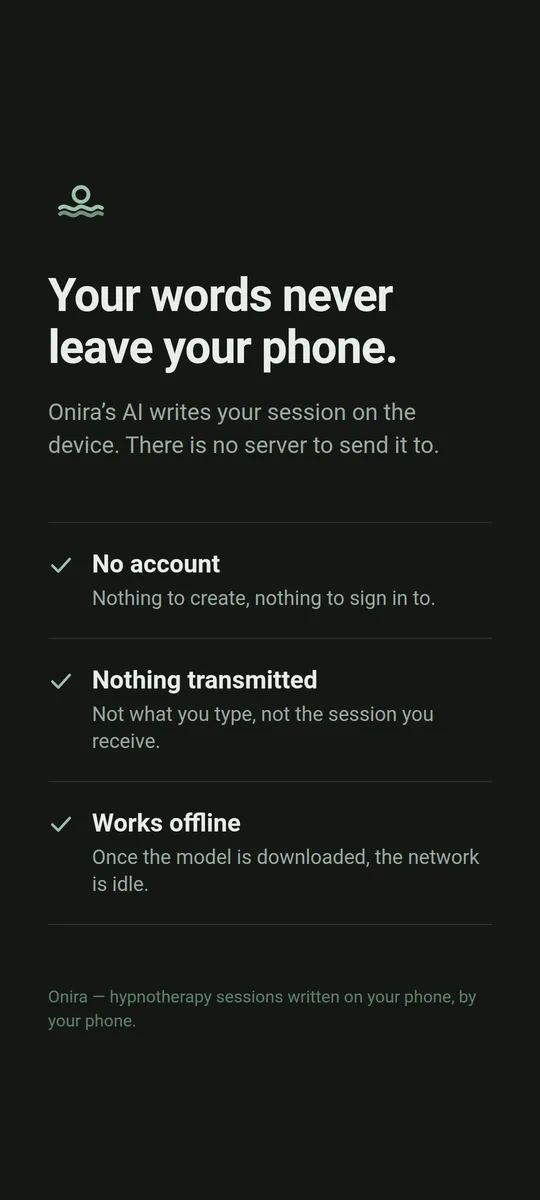
Onira runs its model on your device. The theme you pick, the words you type and the session you receive are never uploaded — there is no account, no cloud generation and no server that could read them.
Not a medical treatment
Onira is a relaxation and self-hypnosis tool. It is not therapy, not medical or psychiatric advice, and not a substitute for professional care or emergency services. If you are in distress or in danger, contact a local crisis line or emergency number.
What a session works on
- AnxietyLoosen the grip of anxious thinking and settle the body.
- SleepWind down a busy mind and let sleep arrive on its own.
- ConfidenceRehearse being the version of yourself you already know how to be.
- StressCome down from a demanding day and recover properly.
- Quitting smokingSupport a decision you have already made, craving by craving.
- FocusSettle a scattered mind before work that needs your attention.
- WeightWork on habits and the relationship with food, not on rules.
- FearFace the flight, the drive or the height with a rehearsed calm.
- MemorySettle into the state where studying actually sticks.
- MotivationStart the thing you have been circling for a week.
- Nervous habitsInterrupt nail biting or jaw clenching before it runs.
- PainEase the bracing and the dread that make pain louder.
- IBSCalm the gut-brain loop that keeps flare-ups going.
- Emotional recoverySettle after something hard, without reliving it.
Questions people ask
- Falling asleepThe method, step by step, for the nights your mind will not stop.
- Hypnosis vs meditationTwo states, two aims — and which one fits what you want tonight.
- Does it work?What the evidence supports, what it does not, and who it fails.
- Street hypnosisReal, not mind control — and the same mechanism works on yourself.
- Learning itWhat to practise, in what order, and how long it really takes.