Home › Does it work?
Does self-hypnosis actually work?
Yes, for some things, moderately, and not for everyone — which is a duller answer than either side of the argument usually gives.
The short answer Self-hypnosis has decent evidence for sleep onset, for pain and procedural distress, and for lowering the arousal that feeds anxiety in a specific situation. It has weak evidence as a standalone treatment for anything clinical, and roughly one person in four responds poorly to suggestion regardless of technique. It is a real tool with a narrow remit, not a cure and not a placebo.
What it is good at
The clearest results are the least dramatic ones. Getting to sleep faster, sitting through a dental or medical procedure with less distress, taking the edge off pain, and going into one identifiable stressful event calmer than you otherwise would. All of these share a shape: a short horizon and a physical component that relaxation genuinely moves.
Habit work — smoking, nail biting, the first ten minutes of an avoided task — sits a step below that. Sessions help, most reliably as one part of a plan rather than as the plan, and the effect comes from repetition rather than from any single session being powerful.
What it is not
It is not therapy, and it does not treat depression, an anxiety disorder, PTSD or an eating disorder. It is not a way to recover forgotten memories — suggestion makes memory less reliable, not more. It is not a substitute for medication anyone has prescribed you, and no honest session will suggest otherwise.
It is also not fast. The marketing around hypnosis leans on single dramatic sessions, and the actual pattern is a modest effect that accumulates with daily use over weeks.
Why it does not work for everyone
Suggestibility varies between people and is fairly stable over a lifetime. Somewhere around one in four people respond weakly to hypnotic suggestion no matter how it is delivered, and about the same proportion respond strongly. That is not a matter of intelligence or willpower, and there is no technique that reliably moves someone from one group to the other.
The practical consequence is worth knowing before you start: if three or four honest attempts do nothing at all, the reasonable conclusion is that this is not your tool, rather than that you did it wrong.
How to tell whether it is doing anything
Judge it on the target, not on the experience. People expect to feel hypnotised and mostly do not — the state is unremarkable from the inside, closer to being absorbed in a book than to anything theatrical. Feeling nothing special during a session says very little about whether it worked.
Pick one measurable thing and watch it for two weeks: minutes to fall asleep, cigarettes in a day, whether you started the task. If the number moves, keep going; if it does not, stop and try something else. That is a better test than any account of how deep you went.
Where Onira fits
Onira is a relaxation and self-hypnosis tool, and deliberately not sold as more than that. What it changes about the usual offering is specificity: instead of a recording made for everyone, a model on your phone writes the session around the theme you pick and the sentence you type, then narrates it aloud.
It runs entirely on the device, so what you type about your own life never leaves the phone — there is no account and no server that could read it. If you are in real distress, that is a conversation to have with a person, and no app is the right answer to it.
Try it tonight

The session narrates itself while a slow-breathing background plays.

Free, no account, no subscription. One-time purchase to remove ads.
Common questions
Is self-hypnosis just the placebo effect?
Expectation is a real part of it, as it is in most of medicine. But hypnotic responding shows up in ways placebo alone does not predict — it varies by trait suggestibility, and imaging studies find state changes that track it. The fair summary is a modest genuine effect with an expectation component on top.
How often should I do a session?
Daily, for two or three weeks, if you are working on a habit or on sleep. The effect is cumulative, and the single biggest predictor of getting anything out of it is having actually done it repeatedly.
Can I get stuck in hypnosis?
No. Without a voice guiding you, the state simply fades or turns into sleep. A session that ends properly includes a deliberate return to full alertness for comfort, not for safety.
Private by design
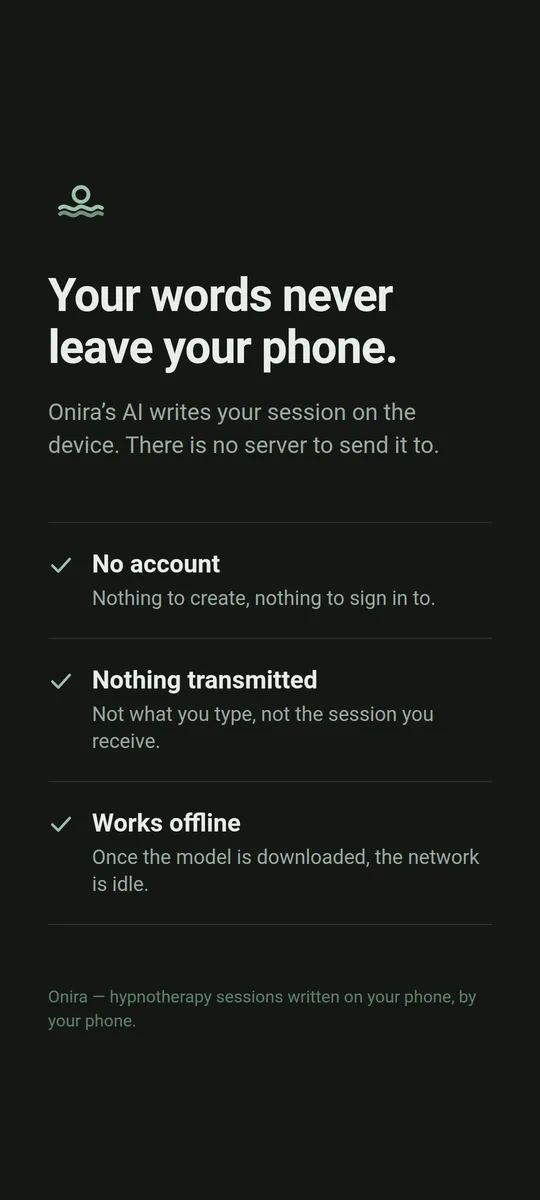
Onira runs its model on your device. The theme you pick, the words you type and the session you receive are never uploaded — there is no account, no cloud generation and no server that could read them.
Not a medical treatment
Onira is a relaxation and self-hypnosis tool. It is not therapy, not medical or psychiatric advice, and not a substitute for professional care or emergency services. If you are in distress or in danger, contact a local crisis line or emergency number.
What a session works on
- AnxietyLoosen the grip of anxious thinking and settle the body.
- SleepWind down a busy mind and let sleep arrive on its own.
- ConfidenceRehearse being the version of yourself you already know how to be.
- StressCome down from a demanding day and recover properly.
- Quitting smokingSupport a decision you have already made, craving by craving.
- FocusSettle a scattered mind before work that needs your attention.
- WeightWork on habits and the relationship with food, not on rules.
- FearFace the flight, the drive or the height with a rehearsed calm.
- MemorySettle into the state where studying actually sticks.
- MotivationStart the thing you have been circling for a week.
- Nervous habitsInterrupt nail biting or jaw clenching before it runs.